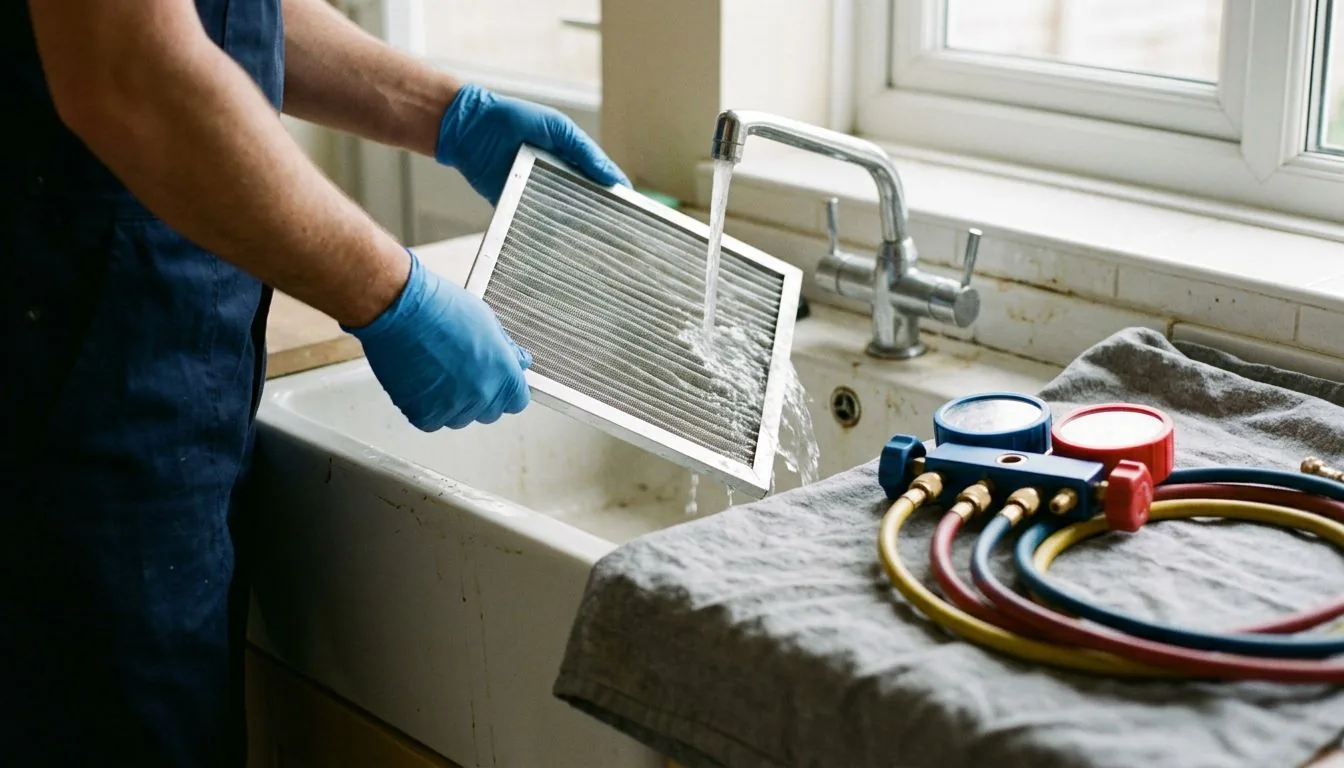
Skipping a service does not usually cause a sudden breakdown. Instead, faults build up in a predictable order: a clogged filter restricts airflow, then a struggling coil, then rising running costs. Left long enough, that strain reaches the compressor, the system’s core part, and can shorten its life. A blocked condensate drain can also cause water damage.
The short answer
Skipping a service does not usually cause a sudden breakdown. Instead, small problems build up in a fairly predictable order, since each fault feeds the next one. A clogged filter comes first, then a struggling coil, then a rising running cost.
Eventually the whole system runs under more strain than it was built for, compressor included. The early signs are easy to miss. The sections below walk through the chain, from the first small sign to the most serious risks.
It starts with the filter, then the coil
A filter’s job is simple: it stops dust reaching the parts behind it. Left unchecked, it clogs gradually rather than all at once, because dust settles in small amounts each day. A clogged filter restricts airflow, so the system has to work harder to move the same air. A filter check is worth asking for on maintenance visits in Swindon, since it is the cheapest fault to catch early.
That extra effort does not fix itself. Energy efficiency guidance from the US ENERGY STAR programme warns that a dirty filter can raise energy costs. It can also damage the equipment and lead to early failure.
Since the fault develops slowly, many owners only notice once the difference is already clear. Our servicing frequency guide is worth reading before a fault sets in.
A restricted airflow problem does not stop at the filter. The coil behind it, where the heat exchange happens, starts collecting the dust the filter should have caught. According to the same guidance, dirty coils reduce a system’s ability to cool. They also make it run longer, which raises energy costs and shortens the life of the equipment.
At this stage, the unit fights two problems at once. Airflow is reduced, and the coil cannot do its job properly. Although neither fault is dramatic on its own, together they pull the system further from how it ran when new.
A coil also sits deeper inside the unit, so it is harder to reach than a filter. It is worth asking whether Poole air conditioning servicing includes a coil check as well.
Running costs climb quietly
A system fighting a blocked filter and a dirty coil runs for longer to reach the same result. That difference rarely appears as one obvious spike. Instead, it shows up gradually across a bill, easy to miss against normal seasonal change.
By the time it is noticeable, the cause has usually been building for months. It is tempting to blame a hot summer. However, the real cause is often a system quietly working harder than it needs to.
The gap rarely looks dramatic in any single month. Still, it adds up across every warm season the fault goes unaddressed. A regular service is the simplest way to stop that slow drift before it starts.
The compressor is what a service really protects
The compressor is the part that pumps refrigerant around the system. Every fault upstream adds to the work it has to do. A system working harder, for longer, puts strain on the compressor that a well-maintained system avoids. Ask whether routine servicing around Cheltenham covers that whole chain, not just the visible parts.
Refrigerant matters here too. The ENERGY STAR guidance notes that too much or too little refrigerant makes a system less efficient. It also shortens the life of the equipment. A service visit checks for signs of that kind of fault while it is still minor.
This is why a service visit checks things that look unrelated to the compressor. A clean filter and a clear coil are not really about airflow for its own sake. Specifically, they keep the compressor working within the conditions it was designed for. If a unit does stop working altogether, our fault-finding guide covers what is safe to check yourself first.
None of the individual checks look dramatic. Together, though, they are what keep the heart of the system out of trouble.
The legal side for larger systems
Some systems also carry legal checks, not just good practice. The F gas rules set leak checks by how much refrigerant a system holds, measured as tonnes of carbon dioxide equivalent. From 5 tonnes upwards, the operator must have the equipment checked for leaks. For most equipment in that band, checks are due at least once every 12 months.
Larger systems need checks more often. From 50 tonnes the interval drops to every 6 months. From 500 tonnes, the system must also have an automatic leak detection system fitted.
If a leak is found, it must be repaired as soon as possible and checked again within a month. A skipped service on a system like this is therefore a compliance problem as well as a mechanical one.
Blocked drains and warranty conditions
A condensate drain narrows gradually as dirt and slime collect inside it. It clogs in much the same quiet way as the filter and coil. Once it blocks completely, water has nowhere to go.
The ENERGY STAR guidance warns that a plugged drain can cause water damage and affect indoor humidity. Water can overflow from the indoor unit, sometimes reaching a wall or floor below. A routine service check clears the drain long before it reaches that point.
Warranty terms can depend on servicing, too. Daikin, for example, states that its warranty is only valid if annual maintenance is carried out, and it can ask for proof. Keeping a simple record of each visit is worth doing, since a later warranty claim can depend on it.
What this means for your enquiry
None of this happens overnight. That is exactly why a regular service catches it while the fix is still small, rather than after it reaches the compressor. Our air conditioning servicing and maintenance service covers homes and businesses across the South West, including Gloucester air conditioning servicing.
If a system has already gone a while without a check, get it looked at sooner rather than later. The earlier the check, the earlier along this chain the fix tends to sit, and the simpler it tends to be.
One enquiry puts you in touch with one pre-qualified installer for this job. It is free, with no obligation.
Send your details through our contact page. Get your system back on a proper service schedule before the next fault builds — get in touch.