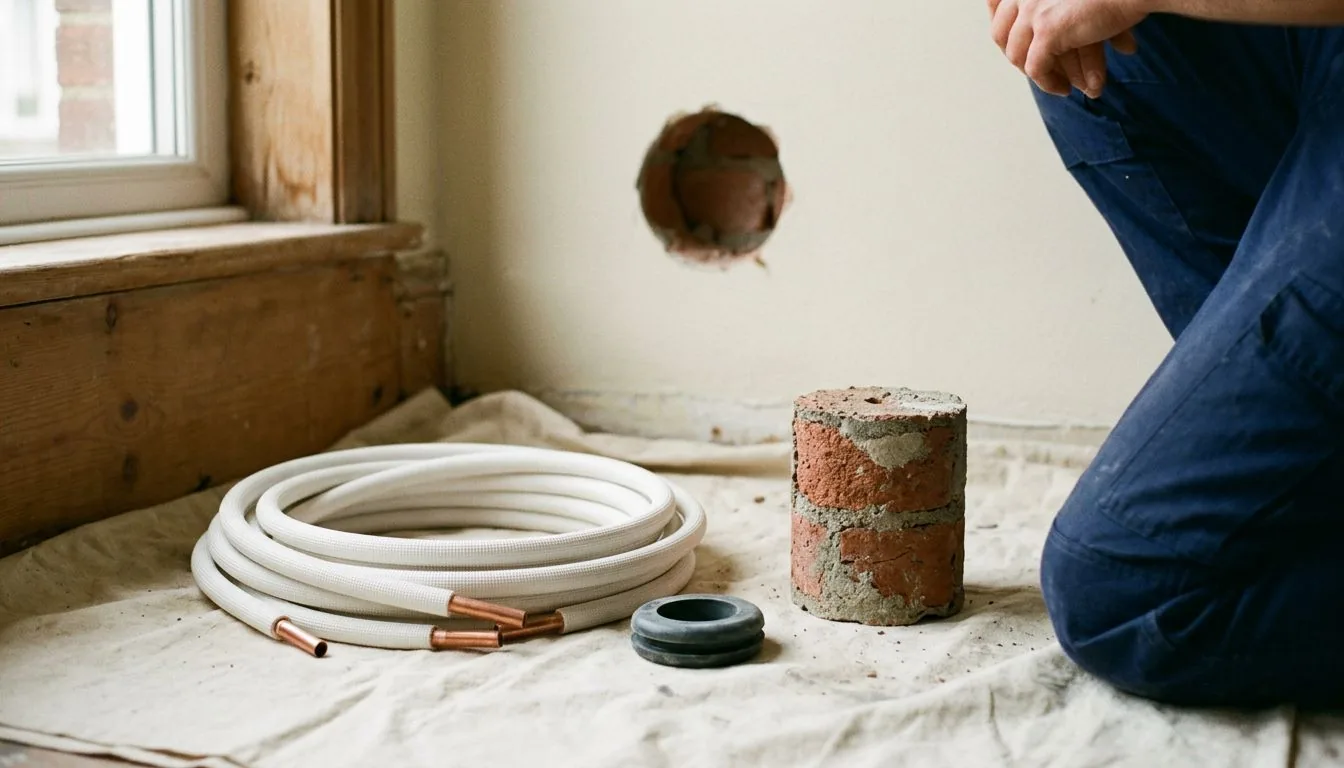
Yes, if the unit is reversible, and GOV.UK research says reversible models are the most common type. A reversible air conditioner is an air-to-air heat pump. It can run its cycle the other way to warm a room. However, outdoor temperature affects its efficiency, so it can suit a top-up role alongside existing heating.
Reversible units, explained simply
A 2025 literature review published on GOV.UK notes that air-to-air heat pumps are commonly called air conditioners in the UK. It adds that reversible models are the most common type. Here, reversible simply means the unit can run one way to heat and the other way to cool. Either way, it moves heat from one body of air to another rather than making it.
In summer, the unit takes heat from inside the room and moves it outside, so the room cools. In winter, it simply runs that cycle the other way. Meanwhile, it draws heat from the outside air and releases it indoors through the same fan unit. Air conditioning vs heat pump covers this reversal in more detail, alongside how it differs from an air-to-water system.
Not every unit is reversible, though, and a cooling-only model cannot heat at all. So it is worth checking the spec sheet before assuming any given unit can heat as well as cool.
What changes about performance as it gets colder outside
A heat pump draws heat from the outside air, so the weather outside shapes how well it works. GOV.UK’s literature review notes that outdoor temperatures vary through the year and affect a heat pump’s efficiency. That is why heat pumps are compared on a seasonal rating rather than a single figure.
The exact effect varies between models, so it is best judged from the unit’s own figures. Still, Daikin UK says there is always thermal energy in winter air, even as low as minus 25 degrees Celsius. So a reversible unit can keep heating through a typical UK winter. It simply performs differently on the coldest days than on a mild autumn evening.
An installer can explain a specific unit’s rated heating capacity. They can also say how it should perform locally, given the area’s typical winter weather. That figure comes from the manufacturer’s own spec sheet, not a general rule of thumb.
Heating and cooling ratings do not automatically match. In GOV.UK’s own modelling, for example, a single-split unit was rated at 2.5kW for heating but 2.0kW for cooling. So it is worth asking about both figures before choosing a unit for the room.
Running it as a top-up vs a main heat source
A reversible unit can work well as a top-up. It warms one room, such as a home office or a converted loft, alongside the existing heating. That suits a room that runs cold in winter but does not need a whole-house fix.
Is air conditioning worth it in a UK home looks at which rooms tend to gain the most. For a home in the city, home cooling installs around Plymouth sets out what a local enquiry involves.
Using it as a main heat source is a bigger step. According to GOV.UK’s literature review, a single split only heats or cools one room. So a home relying on air-to-air for all its heating would need indoor units across its rooms, usually as a multi-split. Sizing each one for winter demand is a different survey from fitting one unit for a single hot room.
Hot water is the other gap. The same review notes that most air-to-air heat pumps do not provide hot water. A home heated this way would therefore still need a separate hot water supply.
How this differs from a dedicated air-to-air heat pump conversion
A reversible split fitted mainly for summer cooling, and a heat pump installed mainly to replace a home’s heating, are similar equipment. Still, the difference is mostly in scope and intent. A whole-house conversion has to cover winter heating load across every room, not just the one that overheats in summer.
Government schemes reflect that difference too. In England and Wales, the Boiler Upgrade Scheme offers a grant towards an air-to-air heat pump, but only under set conditions. The owner must be replacing fossil fuel or electric heating, and the installer must be MCS certified. A single room unit fitted for summer comfort is therefore a different job from that kind of whole-house scheme.
Planning treatment can differ too. In England, permitted development under Part 14, Class G can cover an air source heat pump on a home. Size and siting limits still apply.
Since May 2025, that allowance has included a reversible unit, rather than only a heat-only one. A unit used solely for cooling, however, still sits outside it.
Servicing before the heating season
A reversible unit doing double duty benefits from a check before winter starts, not just before summer. Since it earns its keep in both seasons, a fault in either mode is worth catching early. How often air conditioning should be serviced covers a schedule that works for a unit used across both seasons.
What this means for your enquiry
Tell us whether you want summer cooling, a winter top-up, or both. We will pass the details to one pre-qualified installer, who can advise on the right unit for the job. The air conditioning installation page explains how that enquiry works, with local pages for installation in Truro and installation around Bristol.
One enquiry puts you in touch with one pre-qualified installer for this job. It is free, with no obligation.
Describe the room and how you would use it through the contact page. Say whether winter heating matters as much as summer cooling. The installer we put you in touch with can then advise on the right unit — get in touch.