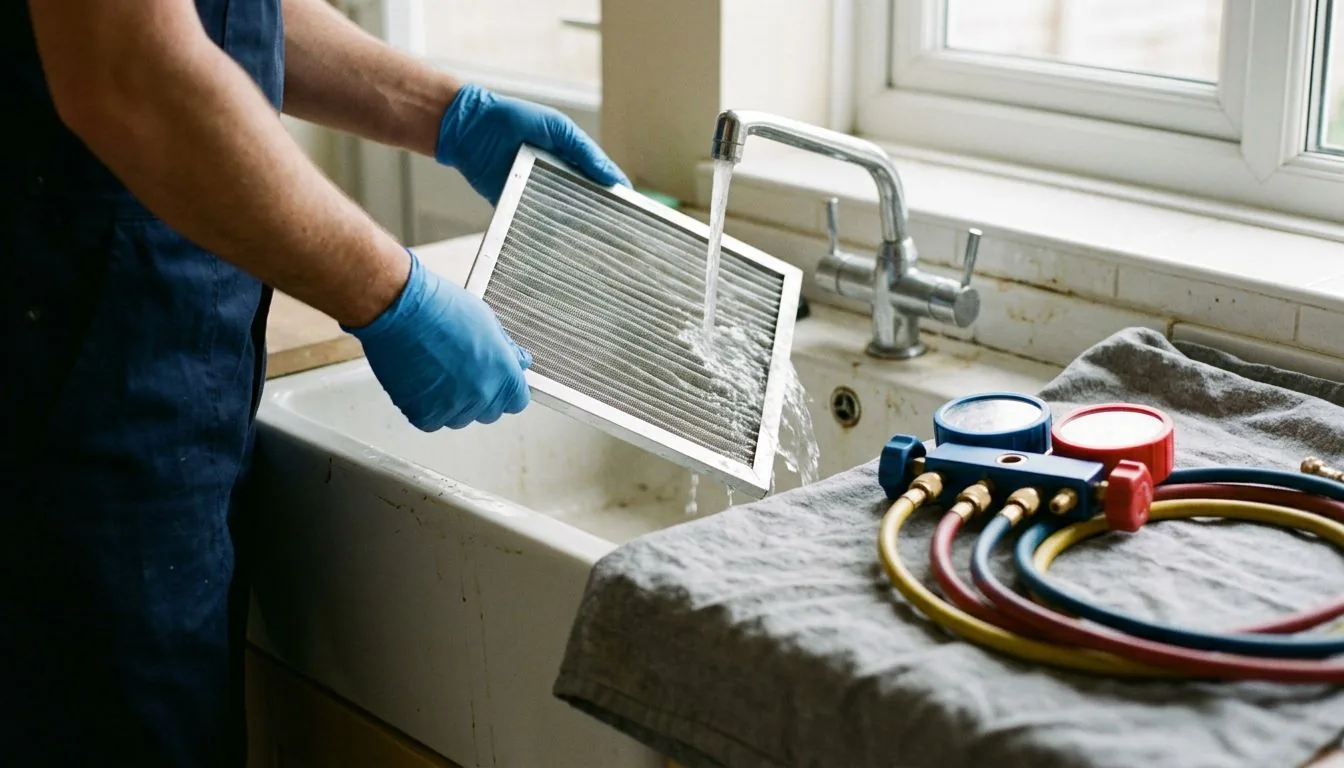
No. A regas tops a sealed system’s refrigerant back up to its correct level. Since the gas moves in a closed loop, a unit that needs topping up every year is losing it somewhere. The right fix is to find and repair that leak under the F-Gas rules, not book another routine top-up.
What “regas” and “recharge” actually mean
A regas, or recharge, tops a system’s refrigerant back up to its correct level. Refrigerant is the fluid that carries heat out of a room. In a split system, it moves in a closed loop between the indoor and outdoor units.
On a split system, the installer completes that loop on site. They join the pipework between the two units, then test and charge the circuit. As a result, once sealed, it should not need topping up on a fixed schedule like washer fluid.
However, many people still treat a top-up as routine servicing. That assumption is wrong. An engineer’s claim that a system “needs a regas” deserves a question, not a quick yes. Why has the charge dropped at all?
Why a sealed system should not lose refrigerant
The clue sits in the word “sealed”. Because the refrigerant travels in a closed circuit, the charge can only drop if gas escapes. Consequently, low charge almost always means a joint, valve or pipe section is leaking somewhere.
This matters because gas loss is never just a small thing. Most refrigerants in UK systems are fluorinated greenhouse gases, or F gases. Releasing them on purpose is against the law, and a leak lets them escape without anyone choosing it.
The leak-checking rules also list the warning signs of low charge. For instance, cooling that falls short, ice forming, or abnormal noise and vibration all count. Oil marks or corrosion near a joint are further clues. Those same signs are a good reason to book air conditioning repair in Taunton rather than a routine service visit.
What a pressure reading tells an engineer
Pressure is one of the readings the leak-checking rules name for spotting a leak. Temperature, compressor current and the amount of gas previously added are others. A reading outside the expected range points to gas leaving the circuit.
However, a reading alone does not end the job. Under the rules, any suspected leak must be followed by a direct test. Specifically, that means an electronic gas detector, an approved dye, or a bubble solution at each joint.
Once the leak is found, the rules set out the order of work. First, the engineer repairs the fault. Next, they pressure-test the circuit, usually with oxygen-free nitrogen, then evacuate and recharge it. A final leak test confirms the repair held.
The rules also ask the engineer to identify the cause of the leak, so it does not happen again. Skipping the leak search and simply adding gas treats the symptom while the fault stays in place. The same drop is likely to return. Before agreeing to air conditioning repair in Salisbury, ask whether the leak will be found first, not just topped up.
Weighing the gas and keeping records
A correct recharge puts back a set weight of gas, not a rough top-up until cooling returns. Air conditioning equipment must carry a label showing how much F gas it contains. That label gives the engineer the figure to work from.
Records matter as well. Similarly, for larger systems, at 5 tonnes of carbon dioxide equivalent or more, the owner must record gas added during maintenance. They must also record the dates and results of leak checks and keep those records for five years.
Furthermore, leak checks become a legal duty at that same size. If a check finds a leak, it must be repaired as soon as possible. A follow-up check within a month then confirms the repair worked. That follow-up timetable applies in law to air conditioning repair in Truro on any system that size.
F-Gas rules and who can legally touch it
Working on these systems requires an F-Gas qualification by law. GOV.UK lists installing, servicing, maintaining, leak checking and recovering gas among the tasks that need it. For example, a Category 2 certificate covers installing, servicing and recovering gas on systems holding less than 3kg. In addition, a company servicing other people’s equipment needs its own certification.
A qualified technician must recover any gas removed during a repair. Nobody may simply vent it to the air. In practice, these rules protect the customer as much as the planet. To check an engineer’s F-Gas category, see what qualifications an air conditioning engineer needs.
Therefore, it is worth asking about qualifications before any work starts. A homeowner rarely gets the chance to check paperwork once the unit is open. It is far easier to ask at the booking stage.
Finding the right engineer for the job
A suspected leak deserves a proper test rather than a guess. Describe the fault, and we check the details before passing them on. A unit that has stopped altogether may have a different fault, and why air conditioning stops working lists the usual ones.
Tell us what the unit is doing through our contact page: get in touch. A clear description helps the installer understand the fault before they arrive. Note when the cooling first weakened, or whether ice has formed on the indoor unit.
Routine servicing, rather than a one-off repair, is a different job. Our servicing and maintenance page sets out what a full check involves. It also covers how often a system is worth booking in, including for air conditioning servicing in Exeter.
One enquiry puts you in touch with one pre-qualified installer for this job. It is free, with no obligation.
The same route covers repair call-outs, not only new fittings. Either way, describe the fault and we will pass it to someone who can take a proper look.