Yes, once a business runs several units or sites. One planned contract beats arranging access again and again, and it keeps F-Gas leak-check deadlines on track. A single office with one unit usually does fine booking a visit as needed instead. Ask what each visit covers before signing, and whether it includes any legal leak checks your systems need.
When one-off call-outs stop paying off
A single visit works fine for one unit in one room. It gets harder once a business runs several units. It gets harder still across more than one site.
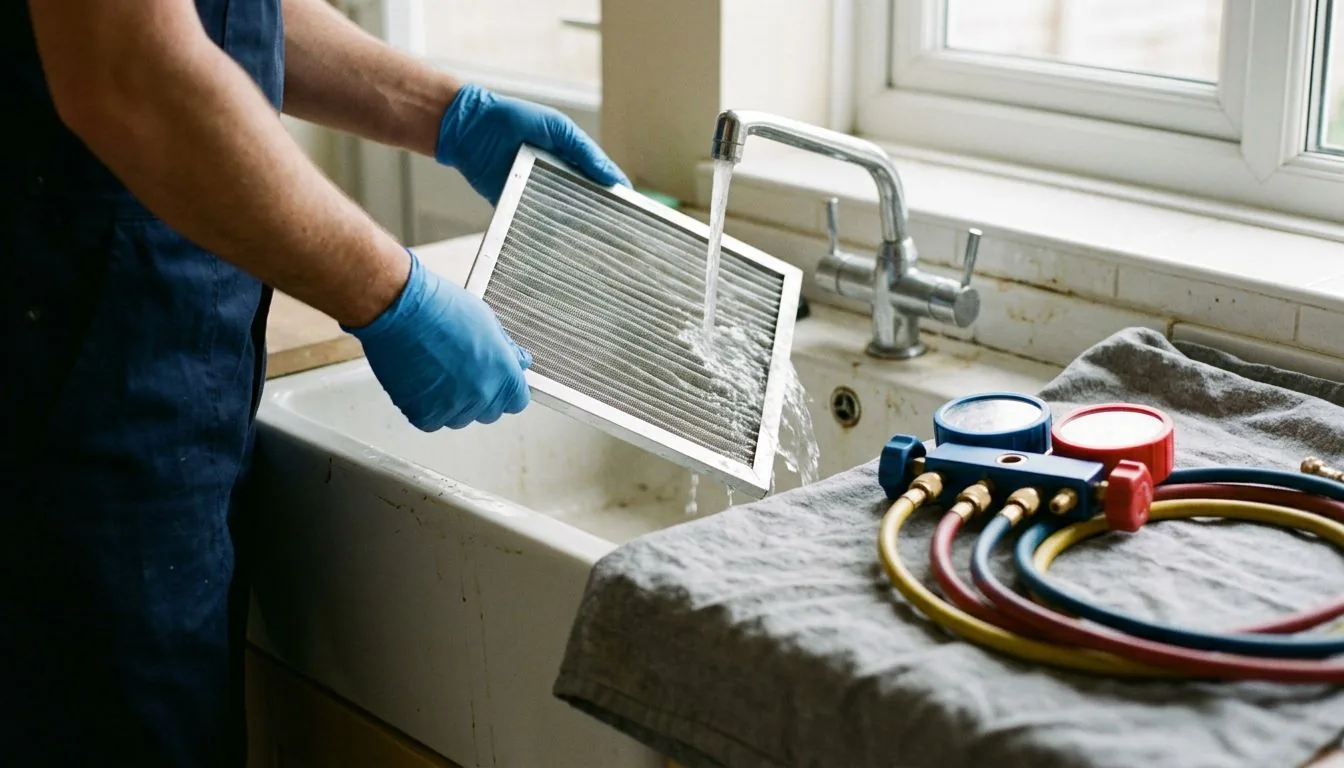
A maintenance contract batches those visits into one yearly plan. That gives a business fixed dates to work with, instead of booking a fresh visit whenever a filter needs a clean. Our servicing and maintenance page sets out what a routine visit covers, whether or not it sits inside a contract.
The real question is about organisation, not whether servicing matters. Does booking each visit separately still make sense once the unit count grows? For many multi-site businesses, the answer changes somewhere along the way.
The legal side: F-Gas leak checks and records
Many business systems also carry legal duties. GOV.UK F-Gas guidance sets them by the gas a system holds, measured as tonnes of carbon dioxide equivalent. From 5 tonnes upwards, the owner must arrange regular leak checks. For example, a system between 5 and 50 tonnes needs checking at least once every 12 months.
Larger systems need checks more often. Between 50 and 500 tonnes, the interval drops to six months. From 500 tonnes, the system must have an automatic leak detection system fitted. On any system, fitting one can double the time allowed between checks.
If a check finds a leak, the owner must have it repaired as soon as possible. The repair then needs a follow-up check within a month. Consequently, a contract that already books certified engineers makes those deadlines easier to meet. Routine servicing runs to its own timetable, which how often air conditioning should be serviced compares with these leak checks.
Records matter too. For equipment at or above the 5-tonne level, the owner must keep details of the gas type and quantity. The records also cover gas added during servicing and the dates and results of leak checks. Those records must be kept for five years, since the Environment Agency can ask to see them.
What a contract usually covers
A typical contract sets a number of planned visits each year. That number should match how each unit gets used, since one flat default rarely fits every site. Ask the installer to explain how they reached the figure for each unit.
The contract should name how many visits it includes. It should also list what each one covers, such as filters, coils, drainage and refrigerant checks. Ask for a short written report after each visit, too. That report becomes a record an owner can point to later.
Ask for the whole scope in writing before anything gets signed. A loose agreement over the phone is hard to check once the year is under way. It also helps to see a sample report first, so you know what a finished one looks like.
Which businesses gain the most
A restaurant group running several kitchen sites is a clear case. Each site has its own opening hours and its own access rules. A retail chain with a unit in every branch is another, particularly once branches sit across several towns.
Similarly, a landlord looking after several tenants can use one contract to keep every unit on one schedule. The same single-contract approach can suit air conditioning servicing and maintenance in Taunton for a business with several sites.
A single small office with one unit rarely needs this. Booking a visit as the need arises usually works fine there. That is because the coordination problem a contract solves barely exists with one unit in one room.
Multi-unit sites and trading-hours access
A small office with three or four units is simple to plan around. A retail chain, a group of kitchens or a shared building is not. Each site brings its own access rules and its own trading hours. In a shared building, a landlord may need to agree access before anyone reaches the outdoor unit.
A contract lets a business agree access windows once. That beats negotiating them for every single visit through the year. It matters most for a kitchen or shop that cannot close for a morning.
Since the schedule gets fixed well ahead, staff can plan around it instead of scrambling at short notice. A fixed schedule also suits air conditioning servicing and maintenance in Salisbury for shops that need visits outside trading hours.
A fixed annual plan also gives a finance team one line to budget against. That is simpler than a stream of separate invoices arriving through the year. For many owners, this predictability matters as much as the servicing itself.
What to ask before you sign
Ask exactly what each visit covers, and whether that scope changes between a kitchen unit and an office one. Ask how a breakdown outside a scheduled visit gets handled. Does it sit inside the contract, or does it count as extra work?
Ask, too, whether the contract includes any legal leak checks your systems need. If it does, check who keeps the F-Gas records and how you get a copy. After all, the legal duty stays with the equipment owner, not the engineer.
It is also worth asking what happens if a unit needs a part mid-contract. That is a different job from routine servicing, and the two should not get confused. A written scope, agreed before signing, clears up that doubt early. A written scope matters just as much for air conditioning servicing and maintenance in Truro.
What this means for your enquiry
Does your site run more than a handful of units, or is access hard to arrange around trading hours? A planned contract is worth weighing against booking visits one at a time. Our commercial air conditioning service covers this alongside new installs and repairs.
Our Bristol commercial page covers business premises in and around the city. Business systems are also sized differently from home ones, as commercial versus domestic air conditioning shows.
One enquiry puts you in touch with one pre-qualified installer for this job. It is free, with no obligation.
Tell us about your site through the contact page. Include roughly how many units you run and how access usually works. The installer we put you in touch with can then talk through whether a contract fits — get in touch.